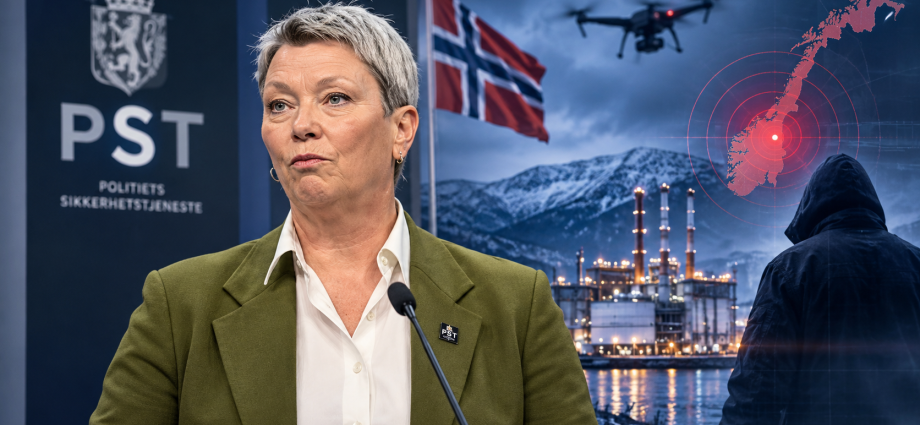
Photo: PST Director Beate Gangås and the escalating sabotage threat facing Norway. Russian intelligence activities pose an increasing challenge to Norwegian security and critical infrastructure. Illustration: Defence and Intelligence Norway.
As a result of a serious deterioration in the threat environment during 2026, the sabotage threat in Norway has now intensified.
The Norwegian Police Security Service (PST) has observed several examples of sabotage operations being carried out across Europe in recent years. Although the number of incidents declined in 2025, the trend has once again reversed in 2026. This applies to completed acts of sabotage, disrupted plots and attempted sabotage operations.
“Developments in the sabotage threat during 2026 have been serious. We believe there are strong grounds to expect Russian intelligence to carry out sabotage operations in Norway over the coming year,” says Inger Haugland, Director of the Department for State Threat Actors at PST.
Various methods are used in sabotage operations, including vandalism, explosives and drones. A recent example occurred in August 2026, when a drone was discovered on the ground near Ukrainian transport aircraft at Leipzig/Halle Airport in Germany. The drone had been modified to carry explosives. German authorities have publicly indicated that Russia may have been behind the incident.
“In addition, several sabotage operations have been carried out through arson. This requires little preparation but can cause extensive damage,” Haugland says.
The majority of sabotage operations in Europe have been carried out by proxy actors. Individuals recruited as proxies may be either aware or unaware that a state actor is behind the operation.
Potential Targets in Norway
The most likely targets in Norway are the defence industry, defence-related businesses and companies providing services to these sectors. This could include, for example, companies involved in logistics operations. Critical infrastructure may also be targeted, including facilities and installations within the energy sector.
“PST has not uncovered any attempts to carry out sabotage operations against targets in Norway. However, PST is aware that actors linked to Russian intelligence have been mapping infrastructure and potential targets in Norway. It is therefore important to monitor and actively counter espionage that may constitute preparations for acts of sabotage,” Haugland says.
The current security policy situation is contributing to an increased willingness among Russian intelligence services to take risks.
“Russian threat actors are adaptable and opportunistic. They exploit both vulnerabilities and opportunities within Norwegian society to advance Russia’s strategic objectives. Western sanctions and countermeasures have reduced the operational freedom of Russian intelligence, but we expect them to adapt and employ new and creative methods.”
PST Appeals to the Public for Information
To help prevent sabotage and minimise its consequences, PST works to ensure that government authorities and other relevant societal actors are equipped to identify threats and protect their assets.
“Given the way the security situation is developing, it is important that PST communicates its threat assessments so that the public and businesses can implement the necessary measures,” Haugland says.
Norwegian businesses are best placed to recognise what constitutes normal activity within their own organisations. PST therefore encourages them to report anything that deviates from the normal situation.
“Tips from the public are important in our efforts to detect and prevent threats against Norway. We would rather be contacted once too often than once too rarely,” Haugland says.
“Sabotage is also intended to spread unrest and fear. This is why it is important to report suspicious incidents to the police or PST, so that we can establish what has actually happened.”
The Sabotage Threat in Norway – What Should Norwegian Businesses Be Aware Of?
Norway’s threat landscape has changed significantly in recent years. Russia’s war of aggression against Ukraine has brought the threat of sabotage by Russian intelligence and security services into sharper focus.
Over the past few years, we have witnessed several examples of sabotage and disruptive activities across Europe. Several of these incidents can be linked to Russian intelligence and security services. One example is the sabotage targeting railway infrastructure in Poland in November 2025.
Sabotage refers to actions intended to destroy or seriously disrupt targets of importance to society. Disruptive activities refer to less serious incidents that create unrest and disturbance in society, such as vandalism and deliberate property damage. Both disruptive activities and sabotage can be carried out digitally or physically.
Russia’s Willingness to Take Risks
Threats from Russia are nothing new. Russia has been mapping Norwegian critical infrastructure, both physical and digital, for a long time. What has changed in recent years is Russia’s intent and willingness to take risks. The security policy situation and the need to expand the range of available instruments are contributing to an increased willingness among Russian intelligence and security services to take risks.
When presenting its 2026 National Threat Assessment in February, the Norwegian Police Security Service (PST) warned that Russian intelligence may see it as advantageous to carry out sabotage operations against targets in Norway during 2026.
The most likely targets for such operations are property and logistics infrastructure associated with support for Ukraine. However, civilian infrastructure could also be affected. The objective would be to create unrest in Norwegian society and exert pressure on Norway’s ability and willingness to continue supporting Ukraine.

Proxy Actors Carry Out Acts of Sabotage
Proxy actors often carry out sabotage and disruptive activities.
Proxy actors are individuals or organisations without formal links to intelligence and security services or other government agencies, who knowingly or unknowingly carry out activities on behalf of, or in support of, other governments.
Such activities may be politically, ideologically or financially motivated.
What Can Norwegian Businesses Do?
Norway’s intelligence and security services work together to prevent, counter and detect acts of sabotage.
For owners and operators of Norwegian businesses and critical infrastructure, the message from the Norwegian National Security Authority (NSM) is clear: The time to act is now.
NSM warns that threat actors will attempt to gain access to business assets, either to steal information or to facilitate sabotage.
Norwegian businesses must therefore understand the risks they face, reduce vulnerabilities and ensure that adequate contingency and backup solutions are in place to minimise the consequences when incidents occur.
What Should Norwegian Businesses Look Out For?
We cannot build fences around or physically secure every asset and every piece of critical infrastructure in Norway. However, we can take preventive measures and reduce the consequences of a potential act of sabotage.
Below are some examples of activities and incidents that Norwegian businesses should remain vigilant about in relation to the sabotage threat:
Suspicious activity around company premises, such as filming, photography or the observation of facilities by unfamiliar vehicles.
Multiple suspicious incidents within a limited period, such as repeated unannounced visits to the company’s main entrance or reception area, or attempts to gain unauthorised access.
Incidents that may indicate attempts to test the organisation’s response to different scenarios.
Repeated attempts to contact employees through digital channels, such as LinkedIn or WhatsApp.
Unexplained or recurring technical failures in systems, or the manipulation of surveillance cameras and lighting.
Employees with access to facilities or restricted areas being approached by unknown individuals.
Unusual conversations or questions during meetings, seminars and conferences involving people associated with the organisation. These may include questions that deviate from normal professional interaction, such as specific interest in the timing or location of stored or delivered equipment and materials.
How to Report Suspicious Activity
Norwegian Police Security Service (PST): Reports can be submitted through the PST reporting portal or by calling its switchboard on +47 23 30 50 00. You can also contact PST’s regional offices.
Norwegian Police: Reports can be submitted through www.politiet.no/tips.
In an emergency, contact the police by calling 112.